

A conversation with Simi Sidhu on late blooming creativity, the craft of reading, and recommended books
Simi Sidhu on coming back to writing after thirty years, and the quote that changed everything
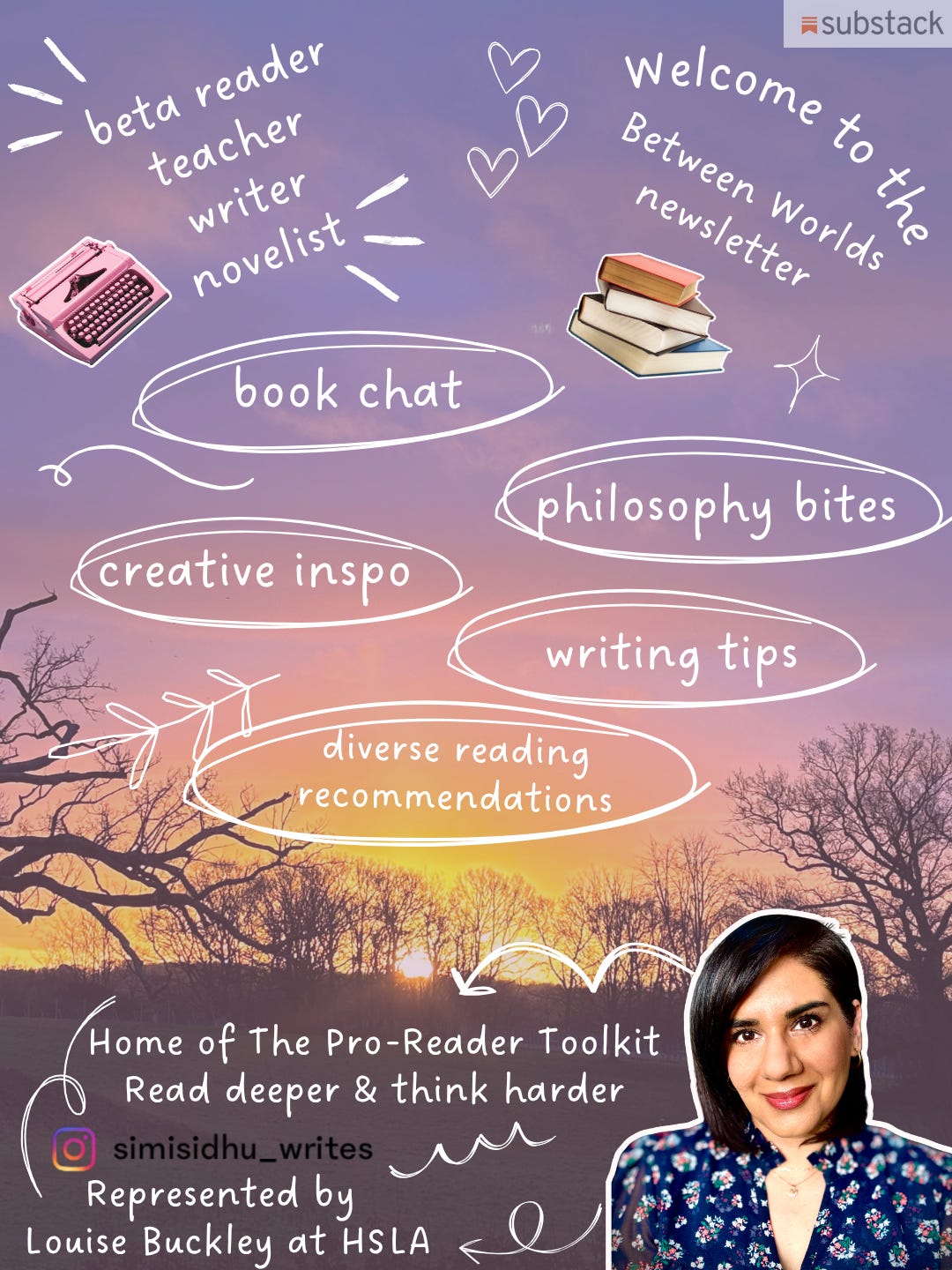
This week, I’m thrilled to share my interview with agented author Simi Sidhu Writes, whose creative life is both hard-won and deeply intentional. After thirty years away from writing, she found her way back to it in midlife, prompted by a single quote that made her rethink the shape of her life and what she wanted the next chapter to look like.
In our conversation, Simi talks about the returning to creativity after so many intervening years, during which she spent time both standing outside of society’s boxes and squarely inside. She also reflects on the many roles she holds as a teacher, educational consultant, beta reader, and author, and the practical routines that help her keep everything in motion.
We also discuss the thinking behind The Pro-Reader Toolkit, her hopes for helping people read more deeply and intentionally, and the books, ideas, and histories that continue to shape her work. I hope you enjoy the conversation as much as I did.
ALICIA: You describe yourself as a late-blooming writer. How did you come into your creativity?
SIMI: Although I wrote a few poems as a teenager, one of which was published in a zine aptly named The Zine, my desire to write faded into the background as I discovered music and the rest of my life started. I never thought I could actually be a proper writer, like Margaret Atwood or Hanif Kureishi, who I read at the time. When I looked at the world of publishing, or journalism, there weren’t many visible women from my background.
I didn’t revisit writing for another thirty years. Although I now have an agent, a book out on submission and my second novel with my beta readers, I didn’t actually start writing again until the autumn of 2023. I’d spent a few months journaling, writing morning pages with my thoughts before I let the noise of the world in. It wasn’t long until I kept returning to the same characters, who built themselves into a scene which developed into a chapter. Without realising that I was walking down the path towards writing a novel, I was partway there.
That book just erupted and poured out of me. I wrote the first draft in a matter of months but in truth the preceding three years had nurtured the conditions for my creativity. It all started with a Confucius quote that I stumbled across while doom scrolling. A quote that led me to questioning my entire existence…
‘We all have two lives, and the second one begins when we realise we have only one.’
I was entering midlife, working as a freelance educational consultant, with a lovely family and a strong group of friends. Busy all the time. I knew I was blessed, but I also realised it had been years since I’d really stopped and reflected on life. I started wondering if I wanted the next 20 years of my life to be more of the same.
I’d inadvertently gone from being a 20-something who never conformed herself into a box of expectation to living a tidy life in the suburbs. I wondered how much of my day was spent doing things that truly brought me joy and how much was routine shaped by society’s rules.
As I gradually stripped away all that had obscured who I really was, for a time my life felt empty. This introspection led to a period of mourning for what I had let go. After this, the space that emerged in my time, in my thoughts, in the pace of life, became the perfect fertiliser for creativity.
ALICIA: You’re a teacher, educational consultant and agented author. Is this difficult and what routines help you to keep all those plates spinning?
SIMI: For me, I could never separate out any of these roles as they each seem fundamental to who I am as a person. I feel that every step I’ve taken in life, each new part of myself that I’ve explored, has been an evolution of who I am at my core.
As a child, I was always squirrelled away somewhere reading. Using the words to fly away into another reality. Through books I learnt about people, what drives us to act and what tethers us to fear. It fed a fascination with the dark and light that we all hold within us, with the parts of the world that don’t fit neatly into boxes of right and wrong. This curiosity to question, society, culture and expectation, is what probably drew me to philosophy.
I studied English Literature and Philosophy at university, spending glorious hours reading and discussing. Breaking down ideas into their core components and reassembling them to fit a new era. I went on to do further study in ethics and in psychology, which deepened my understanding of what it means to think critically and what it means to be human.
For me, my teaching and my writing are all bound up in this fascination with people, culture, society and the world.
I’m very disciplined when it comes to managing my life, which is probably born out of years of balancing freelance work and family. I time-block my days so I always know what I need to be doing and when, whether it’s teaching, consultancy work, fiction writing, Substack writing, health and wellbeing, or my other responsibilities. This stops things falling off my radar.
I’m also a planner, with notebooks that contain multiple lists so when I get to a specific block of time I can always get started with a task straight away. There’s nothing like the dopamine rush of crossing something of that list!
When I’m doing deep work, like writing, I use a timer and leave anything that will distract me in another room. I also try to minimise decision-fatigue (which is the enemy of motivation) by eliminating as many daily decisions as possible like what to eat or what to do at the gym. By keeping these things the same, I free up my mental space for my writing.
ALICIA: You’re also a beta reader and have created The Pro-Reader Toolkit to help people read more deeply and intentionally. What do you hope to teach about the craft of reading?
SIMI: Most of us think reading a book is straightforward. You start on page one and follow it to the end. We tend to believe we’re reading to understand what is happening on the page. It’s one of the first things you learn at school once you can read: comprehension. It’s taught and tested, and it’s a fundamental building block of academic success.
There is more to the craft of reading than making sense of the words on the page and this is what I hope to draw out in The Pro-Reader Toolkit. In a world of fast-reading, fuelled by social media, sometimes readers get to the end of a book and can’t articulate their thoughts beyond whether or not they liked it. Or they move on to the next book so quickly they forget the questions they wanted to discuss.
I want people to get more out of the books they read. To notice more, interpret with more confidence and reflect deeply. I don’t want it to feel like a lesson, so each section is short with specific tasks you can do with the book on your bedside table. It will help you to read actively, notice patterns, track ideas and question the author’s intentions.
I want the Toolkit to remind us that reading is more than just entertainment—it helps us to understand the world around us and examine what it means to be human. It’s as much about understanding the story as it is about understanding ourselves.
It should be just as useful to writers as it is to readers, as it will help writers to better understand how books are built. Each module will develop this awareness into an understanding of how an author crafts a story.
ALICIA: Tell us more about The Pro-Reader Toolkit, which is launching this month.
SIMI: Building on my teaching, consultancy, and critical-thinking facilitation work, I’ve built The Pro-Reader Toolkit for readers and writers who want to think more deeply and read intentionally… who want to slow down and reflect. There are times I want to read a book like I watch a soap opera: no brain power needed. Other times I want to read for emotional depth, philosophical themes and social critique. In a world of fast reading, even I feel the pressure from Bookstagram and Booktok, it’s a space to help you get more out of what you read because the way you read shapes the way you think… and how you think is who you are.
I know that many of us will already have an understanding of literature, remembering words like foreshadowing, imagery, and symbolism from school… but how do we apply that learning to what we read now? Also, writers are told to read widely to refining their craft… but what are they actually looking for? How are they applying it to their own writing?
Each month, I’ll focus on one idea. There will be prompts and questions designed to help us hold onto what we read. Using the lenses of noticing, understanding and reflecting, we’ll learn how to deepen our own interpretation of books, ask better questions and connect books to the world around us. All in an easy-to-understand email, with no pressure to keep up or buy books.
If you want to be more present when you read, deepen your connection with the text and feel that you can truly articulate your thoughts, The Pro-Reader Toolkit is for you.
[NOTE FROM ALICIA: The first post from Simi’s toolkit is now live, and is on what it really means to read.]
ALICIA: Which book do you wish you could read again for the first time, and why?
SIMI: Arundhati Roy’s The God of Small Things. It was published when I was at university and it was the first female South Asian author I remember reading. There was such a buzz about the book, and about Roy. She was so fresh and exciting, not what my tight-knit community had led me to believe Indians were like. I wanted to be her, and if I couldn’t be her, I wanted to be her friend.
Nothing has changed there!
ALICIA: Which books do you find yourself recommending to people?
SIMI: I love recommending books, which is why I started my little Bookstagram account a few years ago. I also share regular book round-ups on my Substack. Rather than focusing on just a few books, which I find impossible to do, it is probably easier to think about the types of books I recommend.
They aren’t confined to one genre, or type of story, but they all have something in common. At their core, they consider fundamental philosophical questions about society and what it means to be human. Alongside a plot that has me racing through the pages, my mind is also whirring, and that’s what I love about books.
A few I’ve recommended recently are The Last Queen by Chitra Banerjee Divakaruni, The Names by Florence Knapp, Big Chief by Jon Hickey and To Paradise by Hanya Yanagihara.
ALICIA: If you could open your own bookshop, what would it look like?
SIMI: Who hasn’t dreamt of opening their own bookshop! Mine would be on the little high street where I live, flanked by cute independent boutiques, and would sit over two floors. Downstairs would be a warren of books, with comfy, worn leather sofas at the back. Upstairs would be a coffee shop, bar and community space, for author readings, writer’s circles and book club gatherings.


ALICIA: Which books are you currently reading, and what’s next on your TBR?
SIMI: My current physical book is Hooked by Asako Yuzuki. I’ve read a lot of Japanese fiction, but this is my first by this author. My current e-book is The Fourth Daughter by Lyn Liao Butler which I downloaded on a whim because I liked the cover. I’m also listening to When the Cranes Fly South by Lisa Ridzén–I’m a huge audiobook listener!
ALICIA: Which books do you wish the younger Simi could have read and why?
SIMI: Rather than specific books, I wish that the younger Simi had known how diverse the world of writing would become and she’d been encouraged to pursue her secret writer dreams. There was a real explosion in the late 90s and 2000s of culture from a range of different groups, including British South Asians, and perhaps if I’d stuck with the writing, I might’ve been part of it.
ALICIA: Are there any books, media or other things you’re especially excited about lately?
SIMI: I’ve been working with the actor and author Jassa Ahluwalia to turn his book about mixed-heritage identity, Both Not Half: A Radical New Approach to Mixed Heritage Identity, into a teaching resource so I’ve spent the last year doing lots of research into people from mixed-heritage backgrounds who’ve been forgotten by history. Jassa has been supporting Kensington Palace with its new exhibition about Princess Sophia Duleep Singh, and I’m really looking forward to seeing this. She is also a descendant of Maharani Jind Kaur, who is the focus of Divakaruni’s novel The Last Queen.
Thank you to Simi Sidhu Writes for her thoughts and insights! You can follow her reading and author journey on her Substack, Between Worlds.
What did our conversation make you think about? Have you ever returned to a creative endeavour after time away, or thought differently about what it means to read intentionally? I’d love to hear your thoughts in the comments, and I hope you’ll subscribe to Reads With Alicia so you don’t miss future interviews and bookish conversations.
 | A guest post by
|
What a pleasure it was to share my booking thoughts with you Alicia… I’ve been reading your book reviews since I joined Substack and hopefully one day you’ll be reviewing on of mine!
Thank you for reading and sharing Arielle!